Step by Step Woond Finishing Technique and Wood Finish Recipe For Custom Drum Builders!
This drum set wood finishing technique and recipe
is ridiculously easy to follow as long as you take it step
by step. The detail is extreme, not because there's anything
complex about it, but because I want to leave absolutely no
chance of guesswork. I practically tell you which hand to
use to unscrew the cap from the can of tung oil -- and if
you have any questions, just ask me...
Warmest Regards,
Bob Coiro
 Between
some advice I found on the internet and a lot of dumb luck,
I was able to produce a surprisingly good tung oil finish
on my shells. Now, there's probably a much easier, more efficient
way to get the job done, so I won't say that mine is the best
way to do it. It's just the method upon which I happened to
stumble and if you should travel down that same meandering
road, you should get to the same destination. This method
makes dust and lint in the air a non-issue, so it's great
for a workshop environment. Between
some advice I found on the internet and a lot of dumb luck,
I was able to produce a surprisingly good tung oil finish
on my shells. Now, there's probably a much easier, more efficient
way to get the job done, so I won't say that mine is the best
way to do it. It's just the method upon which I happened to
stumble and if you should travel down that same meandering
road, you should get to the same destination. This method
makes dust and lint in the air a non-issue, so it's great
for a workshop environment.
I used Minwax Cherrywood
Gel Stain and Minwax Tung Oil Finish. I don't know if it will
work with anything else. I do know you cannot substitute
Formby's Tung oil for Minwax Tung Oil Finish -- I tried
it, it didn't work. The Minwax Gel Stain is oil-based and
the solvents in it are compatible with Minwax's version of
tung oil (which is really an oil/varnish blend). I used
wet/dry sandpaper in the following grits: 220, 320. 400,
600, 800, 1000, 1200, 1500, 2000 and 2500. Grits from 1000
through 2500 can be gotten at an auto body supply store. You
can also get 3M-brand #06334 masking tape in the auto body
supply store. It releases without leaving a residue. Of course,
wear some kind of latex or vinyl disposable gloves and a respirator.
I got one for thirty bucks at Home Depot.
I'll describe the finishing process in exhaustive, tedious,
boring detail -- not to be annoying but to leave absolutely
nothing to the imagination. If someone had done that for me,
I wouldn't have had to strip my shells down to the bare wood
three times (four, if you count the shell I messed up on the
buffing wheel).
Custom Drum Wood Finishing Step 1.) Mask off the inside
of the shell and bearing edges with butcher paper and 3M 06334
masking tape (unless you want to stain and oil the inside
of the shell as well -- I didn't happen to do it that way).
Sand with 220-grit to eliminate the manufacturer's machinery
marks on the wooden shell. Always sand in the direction of
the grain. Use mineral spirits to lubricate the sandpaper
so it will clog up less quickly. Finish up with 320-grit lubricated
with mineral spirits. Wait at least one day before going on
to the next step.
Custom Drum Wood Finishing Step 2.) Apply
a moderately generous coat of gel stain as specified in the
directions on the can. Let it sit about ten minutes and then
wipe off the excess with a cheesecloth, then buff the rest
in with a lintless cotton rag. Always buff in the direction
of the grain.
Custom Drum Wood Finishing Step Step 3.) Wait at least
one day and repeat step 2. Then wait at least one day before
continuing to step 4.
Custom Drum Wood Finishing Step Step 4.) Using a a
hunk of cheese cloth or a foam brush, apply a generous coat
of tung oil to the shell (and when I say tung oil, I mean
Minwax Tung Oil Finish). We want this coat to sink in as deeply
as possible to seal the wood and at least partially protect
the stain therein from future sanding, so be generous with
the tung oil -- flood the exterior of the shell. Let it sit
for ten minutes and then, in the direction of the grain, wipe
away the excess tung oil with a cheesecloth. Return frequently
to buff away the tung oil bleed-back. As tung oil cures, some
of it will tend to squeeze itself back out of the pores of
the wood and then harden as little pinpoint scabs unless you
return to chase the little droplets away. Most of the bleed-back
will take place on this first coat of tung oil. If you don't
happen to catch all the little droplets, it's okay -- you'll
grind them away as there's plenty of sanding yet to do at
relatively coarse grits. Wait at least one day before going
on to the next step.
Custom Drum Wood Finishing Step 5.) The next several
coats of tung oil are sanded in. This will keep your sandpaper
from clogging up and it makes dust in the air irrelevant.
Paint on the tung oil with a foam brush or a hunk of cheesecloth.
Sand it in with 400-grit wet/dry paper. Always sand in the
direction of the grain. Wipe the excess away with cheesecloth
(in the direction of the grain). There won't be quite as much
bleed-back on this second coat, so just return occasionally
to chase it away with a cheesecloth. Wait at least one day
between coats.
Custom Drum Wood Finishing Step 6.) Mix ten parts
of tung oil with one part of mineral spirits. We're thinning
down the tung oil with mineral spirits at this point because
of the finer grit sandpaper. Tung oil that is too thick will
allow the finer grit sandpaper to glide above the wood without
cutting it. Paint on the tung oil/mineral spirits mixture
and sand it in with 600-grit wet/dry paper. Wipe the excess
away with a cheesecloth. Return occasionally to chase away
any bleed-back. Always do your sanding and wiping in the direction
of the grain. Wait at least a day between coats.
Custom Drum Wood Finishing Step 7.) Mix ten parts
of tung oil with one part of mineral spirits. Paint on the
tung oil/mineral spirits mixture and sand it in with 800-grit
wet/dry paper. Wipe the excess away with a cheesecloth. Return
occasionally to chase away any bleed-back. Wait at least a
day between coats.
Custom Drum Wood Finishing Step 8.) Mix ten
parts of tung oil with one part of mineral spirits. Paint
on the tung oil/mineral spirits mixture and sand it in with
1000-grit wet/dry paper. Wipe the excess away with a cheesecloth.
Return occasionally to chase away any bleed-back. Wait at
least a day between coats.
Custom Drum Wood Finishing Step 9.) Mix ten
parts of tung oil with one part of mineral spirits (but if
the sandpaper glides over the wood without cutting, add a
little more mineral spirits to the mix). Paint on the tung
oil/mineral spirits mixture and sand it in with 1200-grit
wet/dry paper. Wipe the excess away with a cheesecloth and
buff the rest in with a lintless cotton rag. Return occasionally
to chase away any bleed-back. Wait at least a day between
coats.
Custom Drum Wood Finishing Step 10.) Mix seven
parts of tung oil with one part of mineral spirits. Paint
on the tung oil/mineral spirits mixture and sand it in with
1500-grit wet/dry paper. Buff with a soft, lintless cotton
rag until almost dry. If the buffing gets difficult or feels
sticky, immediately apply more tung oil/mineral spirits mixture
and keep buffing until almost dry. Return to check for and
eliminate any bleed-back with the lintless cotton rag. Wait
at least a day between coats.
Custom Drum Wood Finishing Step 11.) Mix five
parts of tung oil with one part of mineral spirits. Paint
on the tung oil/mineral spirits mixture and sand it in with
2000-grit wet/dry paper. Buff with a soft, lintless cotton
rag until almost dry. If the buffing gets difficult or feels
sticky as you're buffing, immediately apply more tung oil/mineral
spirits mixture and keep buffing until almost dry. Return
to check for and eliminate any bleed-back with the lintless
cotton rag. Wait at least a day between coats.
Custom Drum Wood Finishing Step 12.) Mix four
parts of tung oil with one part of mineral spirits. Paint
on the tung oil/mineral spirits mixture and sand it in with
2500-grit wet/dry paper. Buff with a soft, lintless cotton
rag until almost dry. If the buffing gets difficult or feels
sticky as you're buffing, immediately apply more tung oil/mineral
spirits mixture and keep buffing until almost dry. Return
to check for and eliminate any bleed-back with the lintless
cotton rag. That's the last of the sanding. Wait at least
a day before the next step.
Custom Drum Wood Finishing Step 13.) Paint
on a full-strength coat of tung oil. Wait five minutes and
then buff it in with a lintless cotton rag. If the buffing
gets difficult or feels sticky as you're buffing, immediately
apply more tung oil/mineral spirits mixture and keep buffing.
As the tung oil starts to dry on the shell and on the rag,
you'll be burnishing tung oil with tung oil, which is what
you want. Buff until the shell feels almost dry to the touch.
Wait at least one day before continuing.
Custom Drum Wood Finishing Step 14.) Repeat
step 13 until the shell develops a high gloss (probably about
four or five times). Let it cure a week before applying any
kind of wax. A simple coat of car wax should do it.
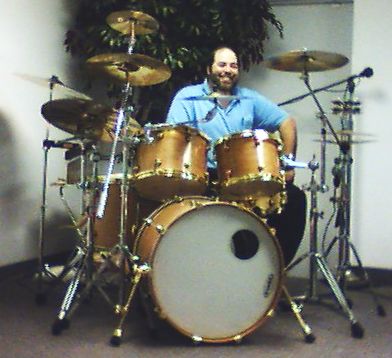
Thanks to Bob
Coiro for his detailed wood finishing technique. We are
very grateful.
You can see Bob's homeade
drum set and gorgeous wood finish in more detail here.
All Images, Text, Everything on this site is Copyright
Protected. All Rights Reserved.
©2005-2012
www.Drum-Building-Secrets.com
|
